
Epitalon and the Telomere Claims
Epitalon is sold on one big idea: longer telomeres, slower aging. The study behind it used fetal cells in a dish, and the mouse data has a detail the marketing leaves out. Here is the full picture.
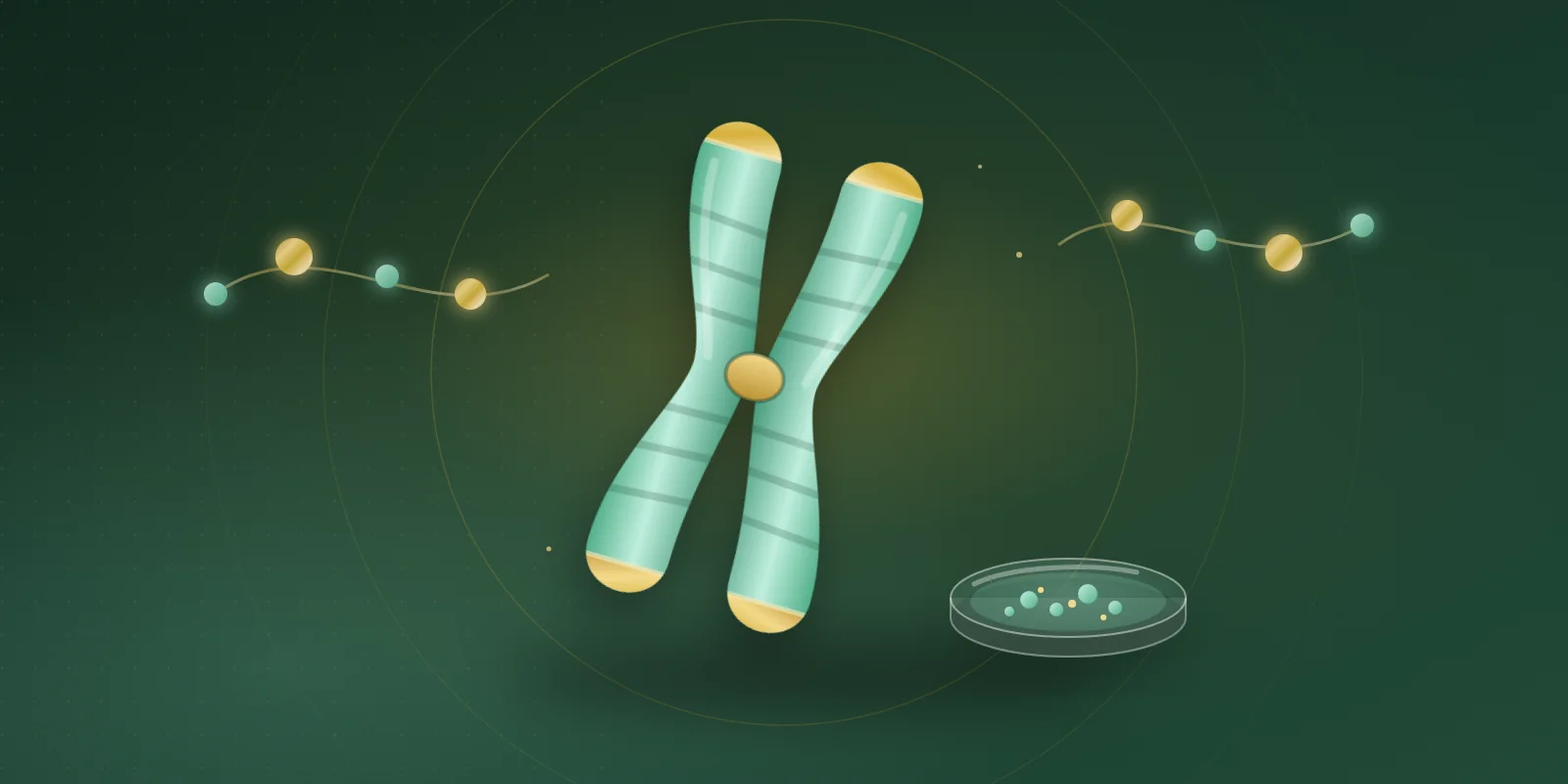
Epitalon's marketing rests on one irresistible idea: telomeres, the protective caps on your chromosomes, shorten as you age, and this four-amino-acid peptide can lengthen them again. There is a real study behind that sentence. There is also a large distance between what that study showed in a lab dish and what is being promised to people buying vials online.
The short version
- Epitalon (also spelled epithalon) is a synthetic four-amino-acid peptide developed in Russia, based on a pineal gland extract called epithalamin.
- A 2004 laboratory study from its developers reported telomerase activation and telomere elongation in human fetal lung cells grown in culture. That is a cell-culture finding, not a human outcome.
- In a 2003 mouse study, epitalon was associated with a 12.3% increase in maximum lifespan but no significant change in average lifespan.
- Most epitalon research comes from one institute. We are not aware of independent, controlled human trials showing it lengthens telomeres, slows aging or extends life.
- Epitalon is not FDA-approved. A July 2026 FDA advisory committee narrowly recommended it for the compounding bulks list, but that vote is non-binding and no final rule has been reported. Rules change; verify with FDA.
Below we explain what telomeres are, what the epitalon studies measured, why "longer telomeres" is not the same as "younger," and the open question about telomerase and cancer that marketing tends to leave out.
Telomeres in two minutes
Each of your chromosomes ends in a telomere, a stretch of repeating DNA that protects the chromosome during cell division, a bit like the plastic tip on a shoelace. Every time most cells divide, the telomeres get a little shorter. When they become critically short, the cell typically stops dividing. This is one of the mechanisms behind the Hayflick limit, the observation that normal human cells in a dish can only divide a limited number of times.
An enzyme called telomerase can rebuild telomeres. It is active in stem cells and certain other cell types, and largely switched off in most adult body cells. Telomere biology earned a Nobel Prize in 2009, and population studies have linked shorter telomeres to older age and to several age-related diseases.
That link is where marketing starts. But association is not causation. Shorter telomeres may partly reflect wear from inflammation, smoking, stress or disease rather than drive them. Lengthening telomeres has not been shown to reverse aging in people.
Where epitalon comes from
Epitalon (Ala-Glu-Asp-Gly) was developed by Vladimir Khavinson and colleagues at the St. Petersburg Institute of Bioregulation and Gerontology, as a synthetic version of what the group identified as the active component of epithalamin, an extract from bovine pineal glands. The same group has published most of the research on both substances over several decades, including human studies of epithalamin in older adults.
Worth knowing
Research concentrated in one institution isn't automatically unreliable, but it hasn't yet passed the test that matters most in science: other independent teams, using their own methods and funding, getting the same result. Until that happens, the fair description is "reported," not "established."
The telomere study, read carefully
The study most often cited is Khavinson, Bondarev, Butyugov and Smirnova, published in the Bulletin of Experimental Biology and Medicine in 2004. The researchers grew fibroblasts, a type of connective-tissue cell, taken from fetal lung tissue. Untreated cells stopped dividing at around the 34th passage. Cells treated with epitalon kept dividing to the 44th passage, and the authors reported increased expression and activity of telomerase and elongation of telomeres.
That is a genuinely interesting laboratory result. Here is what it does not tell you:
- It was in a dish. Cells in culture lack the immune system, circulation, liver metabolism and hormonal environment of a living body.
- They were fetal cells. Fetal fibroblasts behave differently from the aging tissues of a 55-year-old.
- It measured cell divisions, not health. More divisions in a flask is not evidence of better function, fewer diseases or longer life.
- It hasn't been widely replicated. We could not find independent replication in human trials.
The mouse lifespan study
In 2003, Anisimov, Khavinson and colleagues published a study in Biogerontology in which female mice received epitalon injections for five consecutive days each month from 3 months of age until natural death, with 54 animals per group.
The findings as reported:
- No significant difference in mean lifespan compared with controls.
- A 12.3% increase in maximum lifespan, and a 13.3% longer lifespan in the last 10% of survivors.
- No change in total spontaneous tumor incidence, though fewer leukemias were reported in the treated group.
- Fewer chromosome aberrations in bone marrow cells.
That no-change-in-average-lifespan detail is the one to hold onto. The typical treated mouse did not live meaningfully longer. And mouse studies of lifespan are the start of a research program, not proof about humans. Many compounds that looked promising in rodents have never shown the same effect in people.
Be careful here
Telomerase is a double-edged enzyme. Most human cancers switch telomerase on, because it lets cells keep dividing indefinitely. Nobody has shown that epitalon causes cancer, and the mouse study reported no rise in overall tumors. But the theoretical question of whether switching on telomerase in adult tissues could help abnormal cells survive is exactly the kind of long-term safety question that has not been studied properly in humans. Anyone with a personal or strong family history of cancer should treat that gap seriously.
What about "telomere tests" showing improvement?
Some clinics offer telomere-length testing before and after epitalon. Be cautious about reading much into those numbers. Telomere length varies between cell types and between measurement methods, and differences seen in one person over a few months can be within the range of normal variation. A change in a test is also not evidence that you are healthier. A clinician should be able to explain how the test was validated and what a result would change about your care. Often the honest answer is: nothing.
Safety and product quality
Epitalon's developers have described it as well tolerated in their studies. We simply don't have large, independent, long-term human safety data. FDA, reviewing nominated compounding substances, noted that epitalon may pose a risk of immunogenicity for certain routes of administration because of the potential for aggregation and peptide-related impurities.
Most epitalon sold to consumers today comes from "research use only" suppliers outside the pharmacy system, which means no verified identity, purity, concentration or sterility. That is a separate and very practical risk, covered in the research peptide grey market.
Where epitalon stands legally
Epitalon is not FDA-approved. At the July 2026 meeting of FDA's Pharmacy Compounding Advisory Committee, panelists narrowly voted to recommend adding epitalon to the 503A bulks list. FDA's own reviewers had concluded that none of the seven substances considered met the criteria. Advisory votes are non-binding. FDA would need to complete notice-and-comment rulemaking before pharmacies could lawfully compound it from bulk, and as of this writing no final rule has been reported. Rules change, so verify with FDA or ask a clinician for the current position. We explain the process in the July 2026 peptide vote, explained.
Competitive athletes should also check with USADA or their sport's anti-doping body before using epitalon or any peptide. The World Anti-Doping Agency Prohibited List includes a category for substances not approved for human therapeutic use. See peptides and drug testing.
Questions to ask if a clinic offers it
- What human evidence supports this for someone like me? Ask for the citation, and whether the study was in people, animals or cells.
- How is it being lawfully dispensed today, and which licensed pharmacy prepares it?
- What would we measure, and what result would tell us to stop?
- How does my cancer history, or my family's, change the picture?
- Who do I call if I have a reaction?
A provider who answers with confidence but no citations, or treats the legal question as a technicality, is telling you something important. Our full list of questions to ask a peptide provider goes further.
If healthy aging is the goal
The interest behind an epitalon search is usually reasonable: you want to stay healthy and capable for longer. The interventions with the strongest human evidence for that aren't sold in vials: physical activity including strength training, not smoking, managing blood pressure, cholesterol and glucose, good sleep, and treating conditions early. We compare the longevity peptide claims side by side in peptides and longevity, and explain how to weigh studies in what the peptide evidence shows.
If you'd like to discuss your own health goals with a licensed clinician who will be straight about what peptides can and can't offer, our peptide therapy consultations start with your history, risk factors and labs. For many people interested in epitalon, the most useful outcome is a clear plan that doesn't include it.
Common questions
Does epitalon lengthen telomeres in humans?
That has not been shown in independent, controlled human trials. The best-known telomere finding comes from fetal lung cells grown in a laboratory.
Does epitalon extend lifespan?
In a 2003 mouse study, maximum lifespan increased but average lifespan did not change significantly. There is no evidence from human trials that it extends life.
Is epitalon legal to prescribe in the US?
It is not FDA-approved. An advisory committee narrowly recommended it for the compounding bulks list in July 2026, but that is non-binding and no final rule had been reported as of this writing. Check the current status before relying on any provider's claim.
Is epitalon the same as epithalamin?
No. Epithalamin is a pineal gland extract; epitalon is a synthetic four-amino-acid peptide based on what its developers identified as epithalamin's active component.
Curious whether any peptide belongs in your plan? Book a consultation and we'll give you a straight answer.
Talk to a licensed clinician
Reading about a treatment is not the same as knowing whether it fits your history. A consultation is a conversation about your own situation — not a sales call, and not a promise of any outcome.
Book a consultation