Ketamine for anxiety: what the evidence shows so far
Ketamine has shown early signals for some anxiety disorders, but the research is small and short. Here is what the studies show, where they stop, and what usually comes first.
Ketamine has shown early, promising signals for some anxiety disorders, mostly social anxiety and anxiety that has not responded to standard treatment, but the research is small, short and far from settled. It is not FDA-approved for any anxiety disorder, it is not a first-line option, and for most people with anxiety the established treatments should come first. Here is what the studies actually show, and where they stop.
The short version
- No form of ketamine is FDA-approved for anxiety. Spravato is approved only for specific types of depression.
- The anxiety research consists mainly of small trials and open-label studies, often with fewer than 30 participants.
- The strongest early signal is in social anxiety disorder and in treatment-resistant generalized anxiety. Evidence for panic disorder is thin.
- Ketamine reliably reduces anxious symptoms in people being treated for depression, which is a different question from treating an anxiety disorder.
- Therapy and SSRIs or SNRIs remain the evidence-based starting point. Ketamine, if considered at all, belongs later and under supervision.
This is a fast-moving area, and new trials appear regularly. What follows reflects the published evidence as we understand it in late 2026. If you read a claim that ketamine works for most people with anxiety, ask to see the study behind it.
Why researchers are interested
Ketamine acts on the glutamate system rather than serotonin, and its effect in depression appears within hours to days rather than weeks. Anxiety and depression overlap heavily, share brain circuits and often respond to the same medications. It was reasonable to ask whether ketamine's speed would carry over to anxiety disorders, particularly for people who had already tried several standard treatments without success.
There is also a practical reason. A significant share of people with anxiety disorders do not respond well to SSRIs, SNRIs or therapy, and the main fast-acting alternative, benzodiazepines, carries serious long-term risks. A new option would be welcome. That is exactly why the evidence needs reading carefully rather than hopefully.
What the studies show so far
Social anxiety disorder
The most cited controlled study is a small crossover trial in 18 adults with social anxiety disorder, published in 2018 in Neuropsychopharmacology. Each participant received a single IV ketamine infusion and a single placebo infusion on separate occasions. Ketamine reduced symptoms on a clinician-rated social anxiety scale more than placebo did, but the difference did not show up on a self-rated anxiety measure. That split result is typical of how early this research is.
A 2021 systematic review and meta-analysis in Therapeutic Advances in Psychopharmacology pooled the small number of randomized trials across anxiety-spectrum conditions. It found ketamine was associated with response in social anxiety disorder, with higher doses linked to larger effects. The authors described the findings as preliminary.
Treatment-resistant generalized anxiety
A research group in New Zealand ran several small studies in people with generalized anxiety or social anxiety that had not responded to standard treatment. Early open-label work with injected ketamine reported reductions in anxiety within an hour, and a follow-up study gave weekly doses for about three months and reported that many participants stayed improved while treatment continued. Open-label means everyone knew they were getting ketamine, so expectation could account for some of the effect.
Anxiety within depression
Many ketamine trials for depression measured anxiety as a secondary outcome, and anxious symptoms generally improved along with mood. That is useful if your main problem is depression with prominent anxiety. It does not show that ketamine treats generalized anxiety disorder, panic disorder or social anxiety as standalone conditions.
Panic disorder and other conditions
There is very little controlled research on ketamine for panic disorder. Ketamine itself can cause a racing heart, dizziness and a sense of unreality, which are the same sensations that can trigger panic. That does not rule it out, but it is a reason for caution. For PTSD, which is classified separately from anxiety disorders, see our post on ketamine for PTSD.
Worth knowing
Ketamine produces obvious effects, so people in trials can usually tell whether they received it. That makes blinding hard and can inflate results, especially in conditions like anxiety where expectation has a strong influence on how people feel. It is one reason researchers ask for larger trials with active placebos before drawing firm conclusions.
The limits of the evidence
The trials are small. Most have tens of participants, not hundreds. Small studies can produce effects that shrink or vanish in larger ones.
Follow-up is short. Most studies measure days or weeks. We know little about whether benefit lasts after dosing stops.
Long-term safety is not established for repeated use. Frequent, heavy recreational ketamine use is linked to bladder damage, memory problems and dependence. Medical doses are much lower and supervised, but years of repeated dosing have not been studied well.
Formulations differ. Results from IV infusion in a research unit do not automatically apply to a lozenge taken at home.
Who should not use ketamine
Screening matters as much for anxiety as it does for depression. A history of psychosis or bipolar disorder, uncontrolled high blood pressure, significant heart disease, current or past substance use problems, and pregnancy or breastfeeding are generally reasons ketamine is ruled out or needs specialist review. Ketamine can be misused, and people who already use substances to manage anxiety need particularly careful assessment.
Be careful with clinics that lead with ketamine
If a provider recommends ketamine for anxiety before asking what you have already tried, at what doses and for how long, that is a red flag. So is any suggestion that it works for most people or replaces therapy. The FDA warned in 2023 about compounded ketamine used at home for psychiatric conditions without monitoring.
What usually comes first
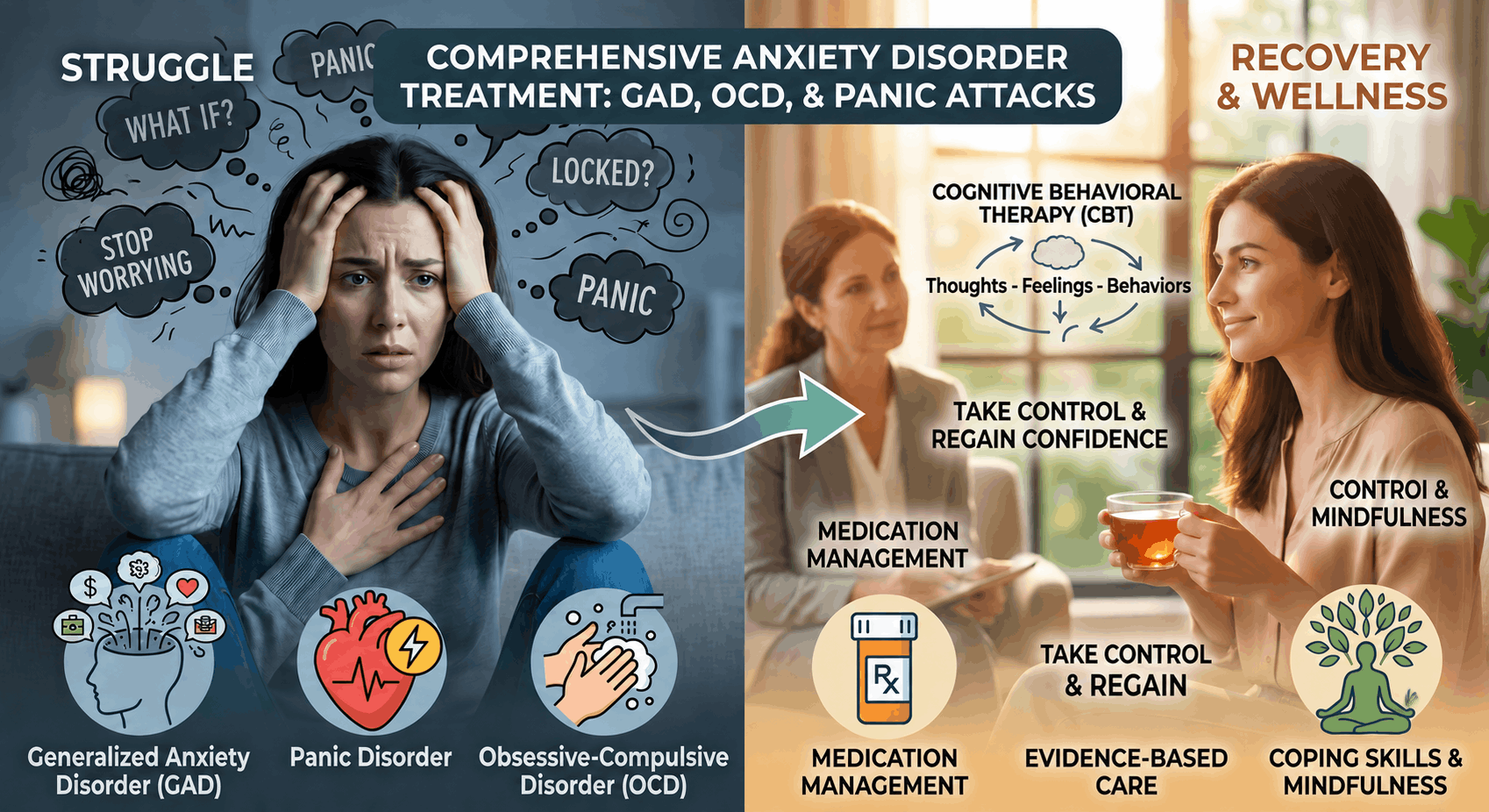
The treatments with the strongest evidence for anxiety disorders are cognitive behavioral therapy, often with an exposure component, and SSRIs or SNRIs. NICE guidance for generalized anxiety disorder, for example, recommends a stepped approach that starts with education and psychological therapy and uses an SSRI as the usual first medication. Buspirone, hydroxyzine and propranolol each have narrower roles. Our guide to anxiety medication options walks through them, and anxiety treatment options, honestly compared covers therapy as well.
Ketamine becomes a more reasonable conversation when several of those have been tried properly and have not worked, especially when depression is also present. Even then, it is an off-label treatment with early evidence, and an honest clinician will say so.
If anxiety is affecting your work, sleep or relationships, an evaluation is the useful first step, whatever treatment you end up considering. Our stress and anxiety service covers assessment and ongoing care, and our ketamine therapy page explains who Aone considers for ketamine and who is screened out.
Questions patients ask us
Is ketamine FDA-approved for anxiety?
No. No form of ketamine is FDA-approved for any anxiety disorder. Racemic ketamine is approved as an anesthetic, and esketamine, sold as Spravato, is approved only for specific forms of depression. Using ketamine for anxiety is off-label. That is legal, but it means there is no approved dose, schedule or monitoring standard for this use.
Which type of anxiety has the most ketamine research?
Social anxiety disorder has the most controlled research, including a small crossover trial of 18 adults published in 2018, though results were mixed between clinician-rated and self-rated measures. There are also small studies in treatment-resistant generalized anxiety. Evidence for panic disorder is very limited. All of it is early-stage.
How fast does ketamine work for anxiety?
In small studies, some participants reported reduced anxiety within hours of a dose, similar to the speed seen in depression research. The effect often faded over days to weeks without repeat dosing. These were small, short trials, so it is not yet clear how reliable or lasting the effect is for anxiety disorders.
Can ketamine make anxiety worse?
It can for some people. Ketamine can cause a racing heart, dizziness, a sense of unreality and dissociation, which may feel like or trigger panic in people prone to it. Some people find sessions frightening. Careful screening, a supervised setting and a lower starting dose can reduce this risk, but cannot remove it entirely.
Does ketamine help anxiety that comes with depression?
Ketamine trials for depression often found that anxious symptoms improved along with mood. That is relevant if depression is the main problem and anxiety is part of it. It does not show that ketamine treats generalized anxiety disorder, panic disorder or social anxiety disorder on their own, which need separate evidence.
Is ketamine better than SSRIs for anxiety?
There is no good evidence that it is. SSRIs and SNRIs have decades of large trials behind them for anxiety disorders and are the recommended first-line medications. Ketamine has small, short studies. It works faster in some research, but speed is not the same as better long-term outcomes, and its long-term safety for repeated use is less well understood.
Is at-home ketamine a good option for anxiety?
It carries more uncertainty. At-home lozenges are compounded products with less research than IV ketamine, taken without trained staff present. The FDA warned in 2023 about compounded ketamine used at home for psychiatric conditions. For people with panic or substance use history in particular, unsupervised dosing adds risk.
Who should not consider ketamine for anxiety?
People with a history of psychosis or bipolar disorder, uncontrolled high blood pressure, significant heart disease, current or past substance use problems, or who are pregnant or breastfeeding are generally excluded or need specialist review. People who have not yet tried established anxiety treatments properly are usually advised to start there instead.
Will insurance cover ketamine for anxiety?
Very unlikely. Because ketamine is off-label for anxiety and the evidence is early, insurers almost always treat it as not covered. Evaluation and follow-up visits may still be billable. HSA or FSA funds can generally be used for prescribed treatment of a diagnosed condition, but confirm with your plan administrator.
Will there be better evidence on ketamine for anxiety soon?
Research is ongoing, and new trials and formulations are being studied. It is reasonable to expect more data in the coming years, but promising early results in small trials do not always hold up in larger ones. Until larger controlled trials report, ketamine for anxiety should be treated as an experimental, later-line option.
Talk to a licensed clinician
Reading about a treatment is not the same as knowing whether it fits your history. A consultation is a conversation about your own situation — not a sales call, and not a promise of any outcome.