Peptides vs HGH vs SARMs vs Steroids: Not the Same Thing
Gym talk lumps peptides, growth hormone, SARMs and steroids together. They are different molecules with different laws and risks, and knowing which is which is the first safety step.
In a gym changing room, "peptides", "GH", "SARMs" and "gear" get used as if they were four brands of the same thing. They are not. They are different molecules, regulated under different laws, carrying different risks, and a sensible conversation about any of them starts with knowing which one you are actually talking about.
The short version
- Peptides are short amino-acid chains. A handful are FDA-approved medicines; most of the ones promoted for fitness are not approved for any use.
- Human growth hormone (HGH) is a large protein and an approved prescription drug for specific conditions. Federal law restricts distributing it for other purposes, including anti-aging and bodybuilding.
- SARMs are small synthetic molecules, not peptides. None is FDA-approved, and FDA says they cannot legally be sold as dietary supplements.
- Anabolic steroids are testosterone and its synthetic relatives. They are federal Schedule III controlled substances. Testosterone itself is an approved treatment for diagnosed hypogonadism.
- For tested athletes, all four families contain substances on the World Anti-Doping Agency (WADA) Prohibited List.
These categories get blurred for a reason. Sellers of unapproved products benefit when a customer assumes that "peptide" sounds gentler than "steroid", or that a SARM is a safer, legal steroid. Neither assumption holds. Below is what each one is, how it is regulated, and what that means if you are weighing any of them. If you want to talk it through for your own situation, that is what our peptide therapy consultations are for, and an honest answer is sometimes "none of the above".
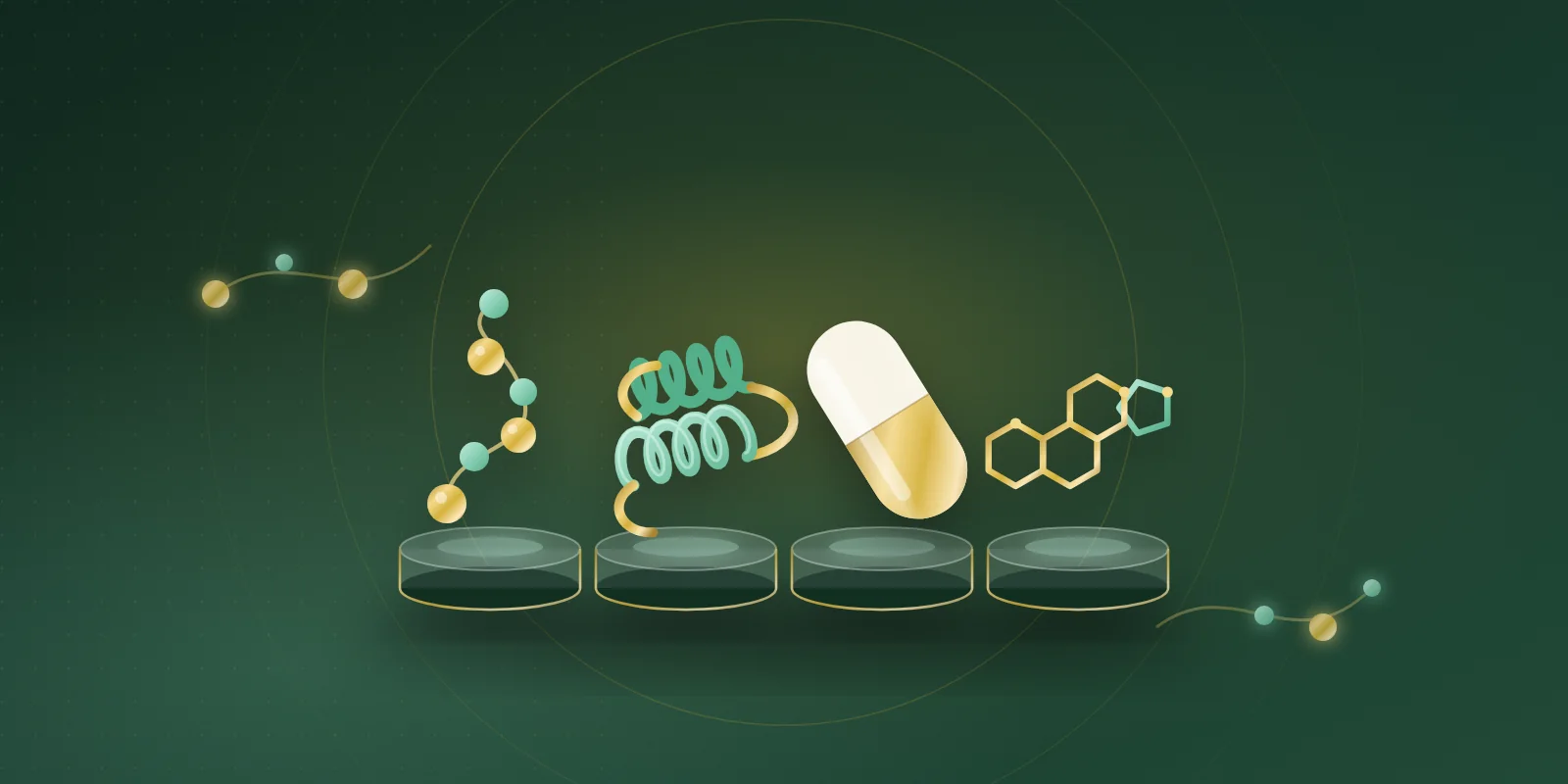
Four families, four different molecules
The simplest way to hold these apart is by what the molecule physically is.
| Family | What it is | FDA-approved examples | US legal frame |
|---|---|---|---|
| Peptides | Short chains of amino acids (FDA treats 40 or fewer as a peptide) | Semaglutide, tirzepatide, tesamorelin, teriparatide | Prescription drugs if approved; compounding rules for the rest |
| Growth hormone | A 191-amino-acid protein made by the pituitary | Somatropin products for defined conditions | Prescription biologic; special federal distribution restriction |
| SARMs | Small synthetic non-steroidal molecules that bind androgen receptors | None | Unapproved drugs; not legal as supplements |
| Anabolic steroids | Testosterone and synthetic derivatives with a four-ring steroid structure | Testosterone products for hypogonadism; a few others | Schedule III controlled substances |
Peptides: a chemistry category, not a safety category
"Peptide" describes a structure. It tells you nothing about whether a molecule is weak or strong, approved or unapproved, safe or dangerous. Insulin is built from peptide chains and can kill in overdose. Semaglutide is a peptide and carries a boxed warning on its label. The word has picked up a wellness glow it has not earned.
There are two quite different groups hiding under the one word:
- Approved peptide medicines, which went through clinical trials and have FDA labeling for a specific use. We list the main ones in the peptide medicines that are FDA-approved.
- Unapproved peptides promoted for recovery, fat loss or "optimization", such as BPC-157, TB-500, CJC-1295 and ipamorelin. None has FDA approval for any use. Their legal availability through pharmacies has shifted repeatedly, and a July 2026 FDA advisory committee vote on several of them did not change the fact that they are unapproved. We explain that vote in the July 2026 FDA peptide vote, explained.
Some fitness peptides are pitched as a way to raise your own growth hormone rather than inject it. That is a real mechanism for a few of them, but "your body makes it" does not make the result low-risk, and it does not make the product approved. We look at that argument in detail in CJC-1295 and ipamorelin explained.
Growth hormone: approved, useful, and tightly restricted
Human growth hormone is not a peptide in FDA's regulatory sense. At 191 amino acids it is a protein, and since March 2020 FDA has regulated protein products like it as biologics.
Prescription somatropin products are approved for defined conditions, including growth hormone deficiency in children and adults, growth failure in several genetic and chronic conditions, HIV-associated wasting, and short bowel syndrome (different products carry different indications). For those patients it is a legitimate, sometimes life-changing treatment, diagnosed with specific testing and monitored over time.
What makes HGH unusual in US law is a specific provision. Under 21 U.S.C. § 333(e), knowingly distributing, or possessing with intent to distribute, human growth hormone for any use in humans other than the treatment of a disease or other recognized medical condition, where that use has been authorized by FDA and prescribed by a physician, is a federal crime. In practice, that means prescribing HGH for anti-aging, general "wellness" or athletic performance is not a gray area for the prescriber. It is outside the law.
Worth knowing
That legal restriction is one reason growth-hormone-releasing peptides became popular: they were marketed as a route to "more GH" that sidestepped the HGH law. The workaround has a cost. Instead of an approved biologic with decades of monitored use, the patient gets an unapproved compound with far thinner human data.
SARMs: marketed as "legal steroids", legally neither
Selective androgen receptor modulators were developed by drug companies hoping to get some of testosterone's effects on muscle and bone with fewer effects elsewhere in the body. Several reached human trials. None has been approved by FDA.
They are small synthetic molecules, not peptides and not steroids, and they are often taken as oral liquids or capsules sold online, frequently labeled "for research only" or marketed as supplements. FDA's position is direct. In a 2023 consumer update, the agency stated that SARMs are not FDA-approved and cannot legally be marketed in the US as a dietary supplement or drug. It linked SARMs to serious problems including increased risk of heart attack or stroke, liver injury including acute liver failure, psychosis and hallucinations, and effects on fertility.
Two things make SARMs especially risky in practice. First, there is no approved product, so every source is unregulated. When researchers bought products marketed as SARMs online and analyzed them for a 2017 research letter in JAMA, many did not match their labels, and some contained other unapproved drugs. Second, because they suppress the body's own testosterone production, some users end up with the same hormonal crash that steroid users experience, without the medical framework to manage it.
Anabolic steroids: controlled substances with an approved cousin
Anabolic-androgenic steroids are testosterone and synthetic molecules derived from it. Under federal law they are Schedule III controlled substances, which means possession without a valid prescription is illegal and prescribing is regulated by the DEA as well as by state medical boards.
Testosterone itself is also an FDA-approved medicine for men with diagnosed hypogonadism, confirmed with symptoms and repeated morning blood tests. That is a legitimate therapy with known monitoring requirements: blood counts, hormone levels, prostate and cardiovascular considerations, and fertility, because external testosterone suppresses sperm production. Our guide to TRT risks and monitoring covers what that supervision looks like.
The gap between medical testosterone replacement and performance steroid use is the dose, the goal and the oversight. Replacement aims to bring a low level back into the normal range. Performance use aims well above it, often with multiple compounds at once, and that is where the well-documented harms concentrate.
Be careful here
Stacking compounds from different families is common in performance culture: a steroid "base", a SARM, a growth hormone secretagogue peptide. Each addition multiplies the unknowns, and no trial has studied these combinations. If you are already using any of these, the safest step is to tell a clinician exactly what you take. You will not be judged for it, and it changes what needs checking. We explain why combinations raise particular concern in why "peptide stacks" are a red flag.
What they share: the athlete problem
If you compete in any sport that tests under the World Anti-Doping Code, including collegiate, Olympic-pathway and many amateur events, the distinctions above matter less than one shared fact: all four families include prohibited substances.
- Anabolic agents (S1) covers anabolic steroids and other anabolic agents, including SARMs.
- Peptide hormones, growth factors, related substances and mimetics (S2) covers growth hormone and growth-hormone-releasing peptides and analogues such as CJC-1295, ipamorelin and tesamorelin.
- Non-approved substances (S0) covers pharmacological substances with no current approval for human therapeutic use. The US Anti-Doping Agency has specifically warned athletes that BPC-157 is prohibited under this category.
The list is updated every year, and a medical prescription does not by itself protect an athlete; a Therapeutic Use Exemption has to be granted in advance for a genuinely needed medication. Check the current list with USADA or your sport's governing body before taking anything.
Which, if any, might be appropriate?
This is where the categories point in very different directions.
- If you have symptoms of low testosterone, the right route is proper testing and, if a deficiency is confirmed, an approved treatment with monitoring.
- If you suspect a growth hormone problem, that is a job for endocrinology testing, not a wellness protocol.
- If your goal is body composition or recovery, the evidence-based foundations (training structure, protein, sleep, and in some cases approved weight-management medication) do far more than any unapproved compound has been shown to do in humans. We are frank about the peptide options in peptides for recovery.
- If you are considering an unapproved peptide, a licensed clinician should explain its current regulatory status, the quality of the human evidence, and whether anything in your history makes it a bad idea.
SARMs and non-prescribed steroids do not have a place on that list. A clinician may still want to know you have used them, because they affect your hormone levels, liver and lipid results.
Common questions
Are peptides safer than steroids?
Not as a category. Some approved peptide drugs have well-characterized risk profiles; many unapproved peptides simply have not been studied enough in humans to know. "Less studied" is not the same as "safer".
Are SARMs legal in the US?
FDA says SARMs are not approved and cannot legally be marketed as dietary supplements or drugs. Products sold as "research chemicals" sit outside the regulated drug system entirely, with no assurance about what the vial or bottle actually contains.
Can a doctor prescribe HGH for anti-aging?
No. Federal law restricts distributing human growth hormone for uses other than treating a disease or recognized medical condition as authorized by FDA. Anti-aging and athletic performance are not approved uses.
Is testosterone therapy the same as taking steroids?
Testosterone is an anabolic steroid, but medically supervised replacement for confirmed deficiency is a different practice from supraphysiologic use for performance. The dose, goal and monitoring are what separate them.
Will a peptide show up on a drug test?
Anti-doping laboratories have developed methods for detecting a number of growth-hormone-releasing peptides, and detection science keeps improving. More to the point, a substance is prohibited whether or not a particular test catches it. Our article on peptides and drug testing goes further.
Laws, FDA positions and anti-doping lists all change. Verify anything time-sensitive with FDA, DEA or USADA directly. If you would like a clinician to look at your goals, history and labs before you decide anything, you can book a consultation. It may end with a prescription, a referral, or a recommendation not to start anything at all.
Talk to a licensed clinician
Reading about a treatment is not the same as knowing whether it fits your history. A consultation is a conversation about your own situation — not a sales call, and not a promise of any outcome.
Book a consultation