Can you travel with medical cannabis on a plane or to another state
Mostly, no. A state card stops at the state line, airports run on federal rules, and the 2026 rescheduling did not change TSA's position. Here is what patients actually do.
In most cases, no. You can't safely take medical cannabis on a plane or across state lines, even between two states where it's legal. A state medical card works within the state that issued it. Some states accept out-of-state cards. Illinois does not. Federal rescheduling in 2026 hasn't changed TSA's position. Here is what the rules say, where the exceptions are, and what patients actually do when they travel.
The short version
- Airport security is federal. In May 2026 a TSA spokesperson said the agency's medical marijuana policy hadn't changed. If officers find cannabis, they refer it to local law enforcement.
- Taking cannabis across state lines can break federal law, whether you're driving, flying or mailing it, and it can break the law of the state you're entering.
- There's no national reciprocity. Michigan's law has protections for visiting patients. Illinois doesn't accept out-of-state cards.
- Hemp-derived CBD products and FDA-approved cannabinoid drugs are treated differently, but hemp rules are also changing.
- Never take cannabis across an international border, including into Canada.
Flying
What TSA says
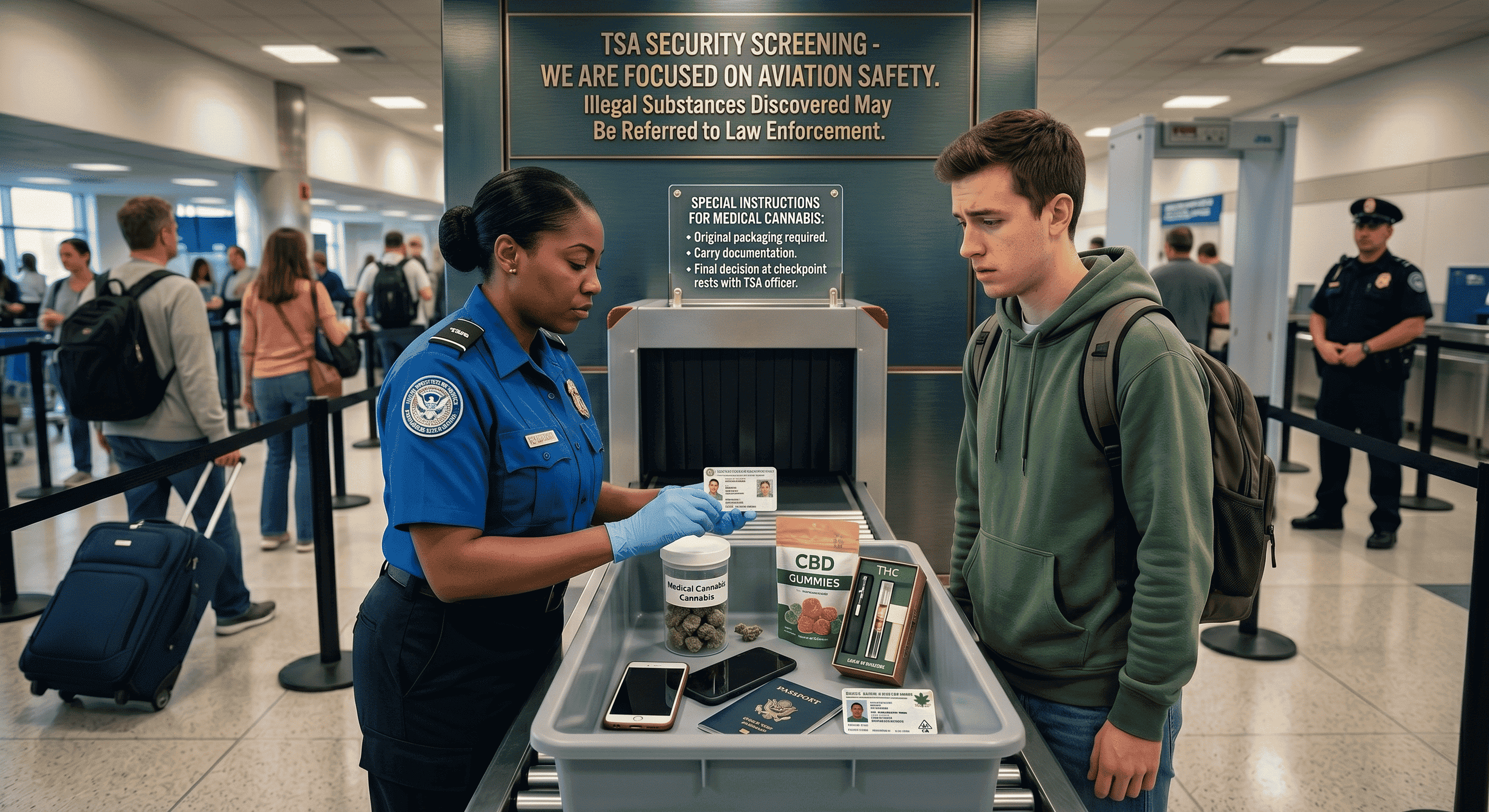
TSA officers screen for security threats, not drugs, but they're federal employees enforcing federal rules. Its "What Can I Bring?" guidance has long said that marijuana and certain cannabis-infused products are illegal under federal law, and that if officers find them during screening, they'll refer the matter to law enforcement. Whether you're arrested, ticketed or just told to throw it away depends on the local police and the state law where the airport is.
After the April 2026 rescheduling order, some outlets reported that patients could now fly with medical marijuana. TSA updated the wording on its website around the same time. A TSA spokesperson then told reporters that the agency's medical marijuana policy had not changed and that the update was only for clarity. That's the position we'd rely on.
Why Schedule III doesn't solve it
The April 2026 order moved marijuana covered by qualifying state medical licenses into Schedule III. Adult-use cannabis stays in Schedule I. The order is being challenged in federal court. Even if it stands, Schedule III substances are normally lawful to carry when they come with a valid prescription. State medical cannabis isn't federally prescribed, and a vape cartridge in your bag doesn't show where it came from. Until federal agencies explain how they apply the change to patients, assume it doesn't protect you at a checkpoint.
CBD and prescription cannabinoids
TSA's guidance has allowed hemp-derived products with no more than 0.3% THC on a dry weight basis, and FDA-approved cannabinoid drugs such as Epidiolex, which is prescribed for certain seizure disorders. Carry prescription products in their original pharmacy packaging. Federal hemp rules are being tightened, and a product labeled "hemp" may contain more THC than the label says, so check the current TSA guidance before you pack anything.
Crossing state lines
Moving cannabis from one state to another can violate federal law and the law of the state you're entering, even if both states have legal programs. Driving from Michigan to Illinois with your Michigan-purchased products is not a gray area. State laws protect you inside the state's borders, and only to the extent they say.
Mailing cannabis is a federal offense as well. Don't ship it to yourself at your destination.
Reciprocity: will another state accept your card?
Each state decides whether to recognize medical cards from elsewhere. There's no national rule.
Visiting Michigan
The Michigan Medical Marihuana Act has a provision for visiting qualifying patients. It gives patients with a valid card from another state some protection under Michigan law for possession within limits. Being able to buy at a Michigan medical provisioning center is a separate question, so check with the store and the CRA. Most adult visitors simply buy at an adult-use store, which is open to anyone 21 and over with valid ID.
Visiting Illinois
IDPH's reciprocity page states that Illinois doesn't accept medical cannabis cards from other states. Visitors 21 and over can buy at adult-use dispensaries, which have lower purchase limits for non-residents. IDPH also lists some other states that accept Illinois cards, with conditions.
Visiting California
California's medical program, including the county-issued Medical Marijuana Identification Card, is for California residents. Visitors 21 and over can buy at licensed adult-use retailers. Patients who need the medical channel for age or other reasons don't have a route as visitors. Our article on recommendations and the MMIC explains the medical side.
Everywhere else
Some states have medical programs that accept out-of-state cards, some have adult-use markets open to visitors, and some prohibit cannabis entirely. Check the regulator's website for your destination before you leave, not when you arrive.
Check before you travel
Reciprocity rules, TSA guidance and hemp rules all changed or were under review in 2026. Confirm the current position with the Michigan Cannabis Regulatory Agency, the Illinois Department of Public Health Medical Cannabis Program, the California Department of Public Health, TSA and your destination state's regulator. Rules change.
Federal land and international travel
National parks, national forests, military bases, federal buildings and many tribal lands follow federal or tribal law, not state law. A state card doesn't protect you there.
Never take cannabis across an international border. Canada legalized cannabis, but it's still illegal to bring it into or out of Canada, and U.S. Customs and Border Protection enforces federal law at U.S. borders and ports of entry. Previous cannabis use, or work in the industry, can also affect whether a non-citizen is allowed into the U.S. Talk to an immigration attorney if that applies to you.
What patients actually do
- Leave it at home. For short trips, many patients just go without and plan for it with their clinician.
- Buy at your destination, if the state allows adult use and you're 21 or older. Buy only what you need and use it up before you leave.
- Ask about alternatives. If cannabis is part of managing a condition, talk to your clinician before a long trip about what to use while you're away. That may be a prescription medication you can carry legally.
- Carry prescription products properly. FDA-approved cannabinoid drugs should stay in their pharmacy packaging with your name on the label.
For an overview of what a Michigan card does and doesn't protect, see the Michigan card guide. For Illinois, see the Illinois program guide. If you're a resident looking for a certification evaluation, start with our Michigan service page.
Questions patients ask us
Can I bring medical marijuana through airport security?
We would not. After the April 2026 rescheduling, a TSA spokesperson said the agency's medical marijuana policy had not changed. TSA screens for security threats, but if officers find cannabis, they refer it to local law enforcement. What happens next depends on the airport's local police and state law.
Does Schedule III mean I can fly with my medical cannabis?
Not in any reliable way. The April 2026 order moved marijuana covered by qualifying state medical licenses into Schedule III, and it is being challenged in court. Schedule III drugs are normally carried with a valid prescription. State medical cannabis is not federally prescribed, and a product in your bag does not show its source.
Can I fly with CBD?
TSA guidance has allowed hemp-derived products with no more than 0.3% THC on a dry weight basis, and FDA-approved cannabinoid drugs such as Epidiolex. Hemp labels are not always accurate, and federal hemp rules are being tightened, so check TSA's current guidance before you pack. Keep prescription products in their pharmacy packaging.
Can I drive my medical cannabis from Michigan to Illinois?
No. Taking cannabis across state lines can violate federal law and the law of the state you enter, even when both states have legal programs. Illinois also does not accept Michigan medical cards. If you need cannabis at your destination and you are 21 or older, buying legally there is the lawful route.
Does Michigan accept out-of-state medical cards?
Michigan's medical marihuana act includes protections for visiting qualifying patients with a valid card from another state, within limits. Whether you can buy at a Michigan medical provisioning center is a separate question for the store and the CRA. Adult visitors 21 and over can buy at Michigan's adult-use stores with valid ID.
Does Illinois accept out-of-state medical cards?
No. IDPH states that Illinois does not accept medical cannabis cards from other states. Visitors 21 and over can buy at adult-use dispensaries, which have lower purchase limits for non-residents than for Illinois residents. Only Illinois residents can register in the state's medical program.
Can I use my medical card in California as a visitor?
California's medical program, including the county-issued Medical Marijuana Identification Card, is for California residents. Visitors 21 and over can buy at licensed adult-use retailers. Visitors under 21 have no legal route to buy cannabis in California, and out-of-state medical cards are not a substitute for a California recommendation.
Can I mail medical cannabis to my vacation address?
No. Mailing cannabis is a federal offense, whether through the Postal Service or a private carrier, and it can also break the law of the destination state. Do not ship products to yourself or have someone send them to you while you are traveling.
Can I take medical cannabis into Canada?
No. Although Canada has legalized cannabis, it is illegal to bring it into or out of Canada. U.S. Customs and Border Protection enforces federal law at U.S. borders and ports of entry. Non-citizens should also know that cannabis use or industry work can affect admission to the U.S., and should consult an immigration attorney.
What do patients do instead when they travel?
Many leave cannabis at home for short trips and plan ahead with their clinician. Some buy at their destination if it allows adult use and they are 21 or older, using it up before they leave. For longer trips, ask your clinician about alternatives you can carry legally, such as a prescription medication.
Talk to a licensed clinician
Reading about a treatment is not the same as knowing whether it fits your history. A consultation is a conversation about your own situation — not a sales call, and not a promise of any outcome.